After twelve years, on the seventh day of Ielool
The Ship Appears
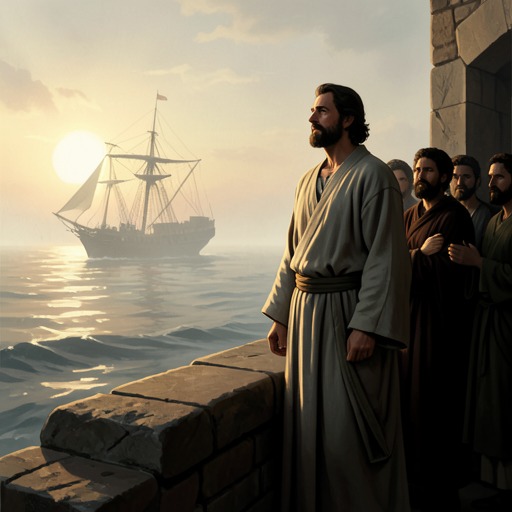
After twelve years in [Orphalese](entity:location-recall-location-orphalese-d6cc834a14c1), [Almustafa](entity:character-recall-character-almustafa-8ddd74c8a7d8) climbs the hill beyond the city walls and sees his ship emerging through the mist. His joy opens into prayer: the long-awaited return to his birthplace is finally at hand.
The sight brings sorrow with it. He has scattered parts of himself through the city and cannot leave the people, memories, and pain of his years there without a wound.
The seventh day of Ielool, shortly after the ship appears
A Farewell on the Hill
Descending the hill, [Almustafa](entity:character-recall-character-almustafa-8ddd74c8a7d8) reflects that staying would mean freezing into a mould, while leaving means tearing away something like his own skin. He longs to take everything he loves with him, but understands that a voice must travel alone, as an eagle flies without its nest.
At the foot of the hill he turns back toward the harbor. The ship is approaching, and its mariners are men of his own land; the crossing from inward decision to actual departure is now close.
The seventh day of Ielool, as Almustafa walks toward the city
The People Gather
As [Almustafa](entity:character-recall-character-almustafa-8ddd74c8a7d8) walks, he sees men and women leaving their fields and vineyards and hurrying toward the city gates. Word of the ship has passed from field to field, and the people are gathering on the very day he must leave.
He wonders what he can give them: whether his heart might become a fruit-laden tree or his desires a fountain. He doubts that his own words and discoveries are a sufficient gift, and imagines raising an empty lantern for the guardian of the night to fill.
The seventh day of Ielool, after Almustafa enters Orphalese
The City Pleads
The people meet [Almustafa](entity:character-recall-character-almustafa-8ddd74c8a7d8) with one voice. The elders ask him not to go, calling him their beloved son; the priests and priestesses confess that their love had remained veiled until separation made its depth plain. Others also entreat him, but he answers only by bowing his head as tears fall.
The crowd and Almustafa proceed to the square before the temple. Their grief makes the departure more than a private homecoming: his years among them have bound him to the city, even as neither their love nor their needs can hold him there.
The seventh day of Ielool, at the temple square
Almitra Asks for Truth
[Almitra](entity:character-recall-character-almitra-2e94450dbe6a), the seeress who first sought and believed in [Almustafa](entity:character-recall-character-almustafa-8ddd74c8a7d8) when he had been in the city only a day, comes out of the sanctuary. She recognizes that the ship has arrived and that his longing for home cannot be bound by the people's affection.
Before he leaves, she asks him to speak of what has been shown to him about life between birth and death. She hopes the people can pass his words to their children and preserve them, and Almustafa answers that he can speak only of what is already moving within their souls.
During the farewell teachings, first in the sequence of questions
Love's Transforming Trial
[Almitra](entity:character-recall-character-almitra-2e94450dbe6a) asks [Almustafa](entity:character-recall-character-almustafa-8ddd74c8a7d8) to speak of love. He describes love as a force that both crowns and crucifies, nurturing a person while also stripping away what keeps the heart from knowing itself. Its trials can be painful, but they open the way to a deeper participation in life.
He warns against seeking only love's comfort and pleasure. Love gives from itself, possesses neither lover nor beloved, and leads its course rather than submitting to human control; those who love should accept tenderness, vulnerability, gratitude, and longing as part of its fullness.
During the farewell teachings, after the teaching on love
Marriage and Space
[Almitra](entity:character-recall-character-almitra-2e94450dbe6a) asks about marriage, and [Almustafa](entity:character-recall-character-almustafa-8ddd74c8a7d8) affirms the partners' lasting togetherness, even in death and in the memory of God. But permanence, he insists, should not become a bond that erases the distance between two souls.
He imagines spouses as strings of a lute, distinct yet sounding together, and as temple pillars standing apart. Their love can be close without turning into possession; each should give a heart without placing it in the other's keeping.
During the farewell teachings, after the teaching on marriage
Children's Own Future
A woman holding a baby asks [Almustafa](entity:character-recall-character-almustafa-8ddd74c8a7d8) to speak of children. He tells the parents that children come through them but do not belong to them: they are expressions of [Life’s longing for itself](entity:concept-recall-concept-life-s-longing-for-it-3220c37aeb64) and carry thoughts and souls of their own.
Parents can offer love and shelter, but should not try to make children into copies of themselves. Almustafa likens parents to bows and children to living arrows sent toward a future the parents cannot enter, urging them to accept the strain of that separation with gladness.
During the farewell teachings, after the teaching on children
The Meaning of Giving
A rich man asks about giving. [Almustafa](entity:character-recall-character-almustafa-8ddd74c8a7d8) says that giving possessions is small beside giving oneself, and that fear of future need can itself become a form of need. He distinguishes gifts offered for recognition from generosity that flows freely, whether it brings joy, pain, or neither.
Giving should not depend on a judgment that the recipient is worthy. Life gives through the giver, he says, and the giver should not make the receiver carry a burden of gratitude; both can rise together through the act.
During the farewell teachings, after the teaching on giving
Eating as Reverence
An innkeeper asks about eating and drinking. [Almustafa](entity:character-recall-character-almustafa-8ddd74c8a7d8) wishes people could live without taking from other life, but accepts that eating entails killing or taking the milk of the young; he therefore asks that the meal be treated as an act of worship rather than thoughtless consumption.
He invites people to remember their kinship with what they eat: the beast's blood and the human's are part of a larger life, while the apple's seeds and the grapes' harvest continue through the body and the seasons. Food becomes a reason for gratitude and remembrance.
During the farewell teachings, after the teaching on eating
Work Made Loving
A ploughman asks about work. [Almustafa](entity:character-recall-character-almustafa-8ddd74c8a7d8) presents labor as participation in the earth's life and in a dream assigned to each person. Knowledge alone is insufficient, he says: work becomes meaningful when joined to love, binding the worker to self, other people, and God.
He illustrates loving work through weaving, building, planting, and making things with care for those who will use them. [Work is love made visible](entity:expression-recall-expression-work-is-love-made-1231caff69a4); work done resentfully can leave its bitterness in bread, wine, and song.
During the farewell teachings, after the teaching on work
Joy and Sorrow Intertwined
A woman asks about joy and sorrow. [Almustafa](entity:character-recall-character-almustafa-8ddd74c8a7d8) says joy is sorrow unmasked: the same well that gives laughter has often held tears, and suffering can deepen the capacity for joy. He compares the heart to a cup fired in an oven and a lute hollowed by knives.
He rejects the idea that one feeling is simply greater than the other. Joy and sorrow arrive together, like companions taking turns at the table and the bed; a person's emotional life remains in motion between them.
During the farewell teachings, after the teaching on joy and sorrow
Houses as Larger Bodies
A mason asks [Almustafa](entity:character-recall-character-almustafa-8ddd74c8a7d8) about houses. He calls a house the larger body, but warns that comfort can turn from a guest into a master, taming the desires it was meant to serve. He imagines homes scattered through fields and valleys rather than crowded behind city walls.
A home should be a mast rather than an anchor: shelter that protects life without trapping its inhabitants. No splendid house, he says, can contain the boundless part of a person, which belongs to the open sky and to the songs and silences of night.
During the farewell teachings, after the teaching on houses
Clothes and Modesty
A weaver asks [Almustafa](entity:character-recall-character-almustafa-8ddd74c8a7d8) about clothes. He observes that garments conceal beauty without hiding what is unbeautiful, and that clothing sought as privacy can become a harness and chain. He wishes people could meet sun and wind with more of their skin exposed to the natural world.
He does not dismiss modesty altogether: it can serve as a shield against the unclean. But if that threat disappeared, modesty could become a fetter of the mind, separating people from the earth and the wind.
During the farewell teachings, after the teaching on clothes
Fair Exchange in the Market
A merchant asks about buying and selling. [Almustafa](entity:character-recall-character-almustafa-8ddd74c8a7d8) says that exchanging the earth's gifts can provide abundance, but without love and justice it leads some toward greed and others toward hunger. He calls on workers and makers to honor what each contributes rather than letting one group sell words in place of labor.
Singers, dancers, and flute players also bring something necessary: their imaginative work nourishes the soul. The market should not close with anyone's needs ignored, because fair exchange includes attention to the least provided for.
During the farewell teachings, after the teaching on buying and selling
Shared Responsibility for Crime
A judge asks about crime and punishment. [Almustafa](entity:character-recall-character-almustafa-8ddd74c8a7d8) resists treating the wrongdoer as a stranger outside the community: the wicked and the righteous exist within everyone, and wrongdoing cannot happen without a wider, often hidden, social will. When one person falls, those who came before and those who follow are implicated in the conditions around the fall.
He asks judges to look beyond an isolated act to its roots and context, including the spirit of the offended and the burdens carried by the condemned. Remorse may already be a form of justice, but understanding justice requires seeing the whole person and the whole community.
During the farewell teachings, after the teaching on crime and punishment
Laws as Human Shadows
A lawyer asks about laws. [Almustafa](entity:character-recall-character-almustafa-8ddd74c8a7d8) compares lawmaking and lawbreaking to children building sand towers beside an ocean, but contrasts that play with people who carve rigid laws into life according to their own fears and limitations. Such people see their shadows and mistake those shadows for the sun.
He questions whether human law can bind those who live freely without harming or imprisoning others. Rules may muffle a drum or loosen a lyre, he concludes, but they cannot command the skylark not to sing.
During the farewell teachings, after the teaching on laws
Freedom's Hidden Chains
An orator asks [Almustafa](entity:character-recall-character-almustafa-8ddd74c8a7d8) about freedom. He has seen people worship freedom while wearing it as a yoke, because the pursuit of freedom can become another harness. People are not free merely because they have no cares; freedom means rising above the cares, wants, and griefs that surround their lives.
He urges them to look inward before seeking to abolish an unjust law or dethrone a despot: the law and tyrant also have a place within the self. Freedom releases one set of fetters only to reveal a greater freedom still to be sought.
During the farewell teachings, after the teaching on freedom
Reason Meets Passion
The priestess asks about reason and passion. [Almustafa](entity:character-recall-character-almustafa-8ddd74c8a7d8) describes the soul as a battlefield where judgment and appetite contend, and hopes that people can become peacemakers who love all their own elements rather than suppressing one side.
Reason and passion are the rudder and sails of the seafaring soul: reason alone confines, while passion alone burns itself out. Each must guide and elevate the other, as two honored guests sharing one house and as stillness and storm both revealing different movements of God.
During the farewell teachings, after the teaching on reason and passion
Pain Opens Understanding
A woman asks [Almustafa](entity:character-recall-character-almustafa-8ddd74c8a7d8) to tell them of pain. He describes it as the breaking of the shell around understanding, like a fruit stone breaking so its heart can meet the sun. Pain and joy belong to the seasons of the heart, and grief can be watched with the same patience people grant the winters of their fields.
Much pain, he says, is self-chosen: a bitter remedy administered by the physician within. His counsel is not to deny its severity, but to trust that the process can heal what is sick in the self.
During the farewell teachings, after the teaching on pain
The Boundless Self
A man asks about self-knowledge. [Almustafa](entity:character-recall-character-almustafa-8ddd74c8a7d8) says that the heart already knows more than the ears can hear, though that inward knowledge must rise and become visible, like a hidden spring running toward the sea. He cautions against trying to weigh or measure the treasure of the self.
He asks people to say they have found a truth rather than the truth, and to see the soul as meeting them on their path rather than belonging to a single path. The soul unfolds like a lotus with countless petals, beyond any fixed line or measure.
During the farewell teachings, after the teaching on self-knowledge
Teaching Leads Inward
A teacher asks [Almustafa](entity:character-recall-character-almustafa-8ddd74c8a7d8) about teaching. Almustafa says that no person can reveal what does not already lie half asleep within another; a wise teacher offers faith and love, then guides a student to the threshold of their own mind.
An astronomer can speak of space and a musician can sing its rhythm, but neither can transfer another person's vision or ear. Each person must stand alone in understanding the earth and in knowing God.
During the farewell teachings, after the teaching on teaching
Friendship Deepens the Spirit
A youth asks [Almustafa](entity:character-recall-character-almustafa-8ddd74c8a7d8) about friendship. He describes a friend as a field cultivated with love, a place of nourishment and peace, and someone whose spoken or unspoken thoughts can be received without fear. Friendship can make what is loved clearer through absence, just as a mountain appears more clearly from the plain.
Its purpose is not usefulness but the deepening of the spirit. Friends should share not only the low ebb but also the flood of their lives, and approach one another with hours to live rather than hours to kill.
During the farewell teachings, after the teaching on friendship
Speech and Silence
A scholar asks [Almustafa](entity:character-recall-character-almustafa-8ddd74c8a7d8) about talking. He suggests that people often speak when they are no longer at peace with their thoughts or cannot bear the solitude of the heart. Much talking, he says, half-murders thought, which is like a bird whose wings cannot fly inside a cage of words.
Yet silence is not the only truth: some people speak without fully understanding the truth they reveal, while others carry truth without putting it into words. When friends meet, the spirit within the voice should guide speech, so that what is said remains in the listener beyond its sounds.
During the farewell teachings, after the teaching on talking
Time Without Division
An astronomer asks [Almustafa](entity:character-recall-character-almustafa-8ddd74c8a7d8) about time. He observes that people try to measure the immeasurable and arrange their conduct and spirits by hours and seasons, as if time were a stream that could be watched from its bank. Yet the timeless within them knows yesterday as memory and tomorrow as a dream of today.
Love, too, is undivided and without pace. If people must reckon time in seasons, he suggests, each season should contain the others: the present can embrace the past through remembrance and the future through longing.
During the farewell teachings, after the teaching on time
Good and Evil Within
An elder asks [Almustafa](entity:character-recall-character-almustafa-8ddd74c8a7d8) about good and evil. He speaks of evil as good tortured by hunger and thirst, and distinguishes failing to be good from being evil: a divided self is divided, not therefore a den of thieves. People who seek their own gain may be as necessary to life as roots are to fruit.
He describes goodness as a longing for the fuller self, a longing that moves quickly in some and slowly in others. Those who are strong or spiritually eager should not shame people who move more slowly; genuine goodness does not interrogate the naked or the houseless about what they lack.
During the farewell teachings, after the teaching on good and evil
Prayer Beyond Asking
A priestess asks [Almustafa](entity:character-recall-character-almustafa-8ddd74c8a7d8) about prayer. He wishes people would pray not only in need and distress but also in joy and abundance, allowing both darkness and the heart's dawning to expand into the living ether. Prayer is communion rather than a means of obtaining favors or proving humility.
Almustafa says he cannot teach a formula of words: God hears words when God speaks through the person. He offers instead a prayer in which people recognize that divine will, desire, and need already move within them, and that receiving more of God is receiving all they need.
During the farewell teachings, after the teaching on prayer
Pleasure's Shared Gift
A hermit who visits the city once a year asks about pleasure. [Almustafa](entity:character-recall-character-almustafa-8ddd74c8a7d8) calls it a song of freedom rather than freedom itself, and encourages the young to seek it without condemning them. Pleasure may lead to discoveries beyond itself, while regret need not turn past delight into a wrongdoing.
He warns that denying pleasure can merely store desire away, and describes the body as the harp of the soul. To distinguish a life-giving pleasure, he points to [Bees](entity:creature-recall-creature-bees-40893e822389) and flowers: each gives and receives, and their mutual exchange is both a need and an ecstasy.
During the farewell teachings, after the teaching on pleasure
Beauty as Revelation
A poet asks [Almustafa](entity:character-recall-character-almustafa-8ddd74c8a7d8) about beauty. He recounts how different people imagine it according to their own longings: gentle to the injured, powerful to the passionate, quiet to the weary, and fierce to the restless. These descriptions reveal unsatisfied needs as much as they reveal beauty.
Beauty, he says, is not a need but an ecstasy: an inner image and song that remain even when the senses are closed. It is life unveiling its holy face and eternity gazing at itself in a mirror, while people are at once the life and the veil, the eternity and the mirror.
During the farewell teachings, after the teaching on beauty
Daily Life as Religion
An old priest asks [Almustafa](entity:character-recall-character-almustafa-8ddd74c8a7d8) about religion. Almustafa answers that he has spoken of little else, because religion includes deeds, reflection, and the wonder that arises even as people work. Faith cannot be separated from occupations, or the day neatly divided into hours for God and hours for the self.
He calls daily life a temple and religion, asking people to bring their work, craft, music, achievements, failures, and fellow human beings into it. To know God, they need not solve riddles: they can look for the divine among children, clouds, lightning, rain, flowers, and trees.
During the farewell teachings, after the teaching on religion
Life and Death as One
[Almitra](entity:character-recall-character-almitra-2e94450dbe6a) asks about death. [Almustafa](entity:character-recall-character-almustafa-8ddd74c8a7d8) says its secret cannot be found outside life, just as an owl blind by night cannot disclose the mystery of light. Life and death are one, as a river and the sea are one, and the heart's hopes and desires already contain a silent knowledge of what lies beyond.
He recasts fear as the shepherd's trembling before a king who will honor him. Death is standing naked in the wind and melting into the sun; when earthly limbs are claimed, a deeper dance begins. His answer prepares the people to understand his departure as transformation rather than simple disappearance.
The evening of the seventh day of Ielool, after the final teaching
The Farewell Blessing
As evening falls, [Almitra](entity:character-recall-character-almitra-2e94450dbe6a) blesses the day, the place, and the spirit that has spoken. [Almustafa](entity:character-recall-character-almustafa-8ddd74c8a7d8) asks whether he was the speaker or also a listener. He descends the temple steps with the people and reaches his ship, where he turns to address them once more.
He says the wind bids him leave, though his love makes him less hasty than the wind. He hopes his voice and love will not vanish from their memory, promises to return, and likens himself to mist that disappears at dawn only to gather again as a cloud and fall as rain.
The evening of the seventh day of Ielool, during Almustafa's final address
The Vast Man Revealed
In his farewell, [Almustafa](entity:character-recall-character-almustafa-8ddd74c8a7d8) tells the people that he has known their joys and pains and found something greater than any one person's laughter or longing: the vast being within them all. In beholding that shared life, he explains, he has beheld and loved the people themselves. They are not measured only by their smallest deeds or failures; they are also as strong as their strongest link.
He insists that their lives exceed their bodies, houses, and fields. The apparently weak and bewildered within them can be their most determined force, while life itself is conceived in mist rather than crystal. He asks them not to force clarity upon what remains mysterious, but to remember him as a beginning.
The evening of the seventh day of Ielool, after the farewell address
The Ship Sails East
[Almustafa](entity:character-recall-character-almustafa-8ddd74c8a7d8) tells the people that their welcome has given him a deeper thirst for life, and that even as he drinks from the living fountain, it drinks him. He explains that his distance and solitude were not indifference: he sought their deeper selves, and the search turned back upon him, making him both hunter and hunted, believer and doubter.
At last he tells the patient captain that he is ready. The stream has reached the sea, and the great mother holds her son again. The mariners weigh anchor and steer eastward; the people cry out together, while [Almitra](entity:character-recall-character-almitra-2e94450dbe6a) remains silent on the sea wall, watching until the ship vanishes into mist and remembering his promise of return.